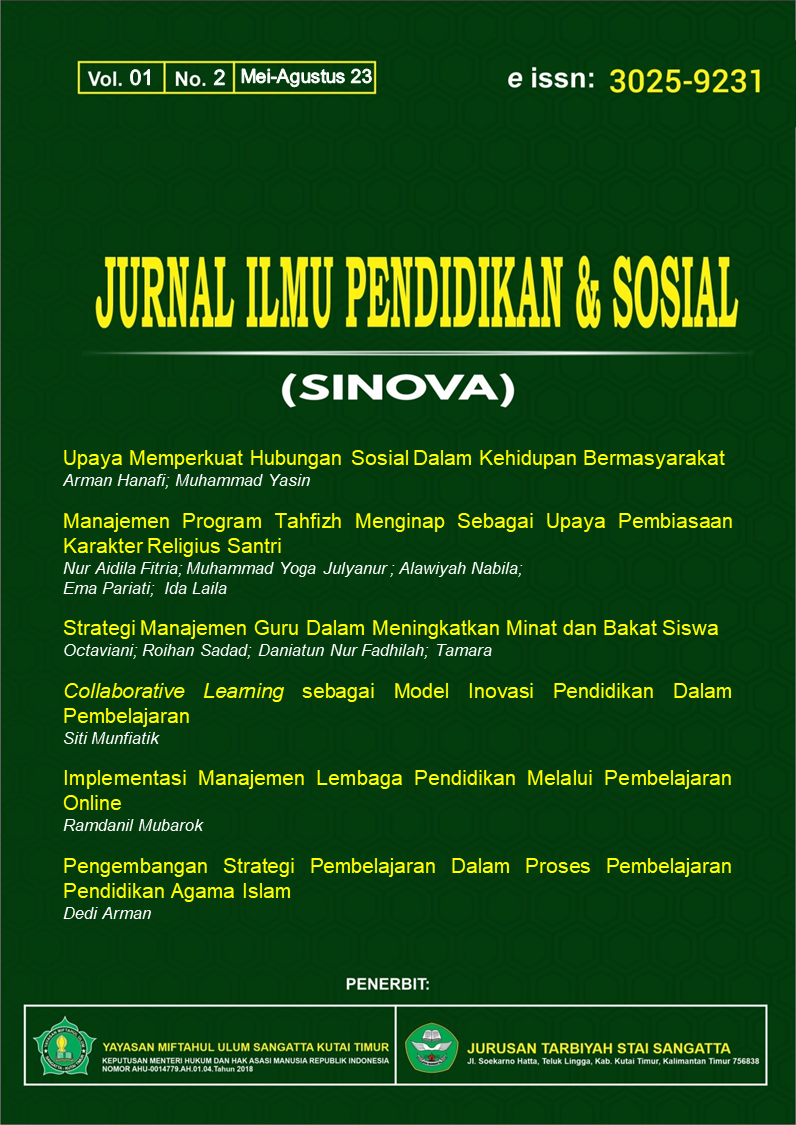
Pengembangan Strategi Pembelajaran Dalam Proses Pembelajaran Pendidikan Agama Islam
DOI:
https://doi.org/10.71382/sinova.v1i2.120Keywords:
Strategic Development, Learning Process, Islamic EducationAbstract
The aim of this study is to analyze the importance of PAI learning, the challenges faced in the learning process, and the relevance of the development of learning strategies in the context of Islamic education. The method applied in this research is the method of library research with steps: identifying research topics, identifying keywords, searching for literature, scrutinizing literature, analyzing literacy, writing literature summaries, and drawing conclusions. As a result, the importance of PAI learning in the context of education is not only limited to theological understanding but also covers important aspects in the formation of Muslim individuals who are characteristic and contribute positively to society. As for the challenges in the learning process: less relevant use of technology, integration of Islamic values in less-favorable lives, and less conducive learning environments. While the relevance of strategic analysis in the PAI learning process can increase student learning interest and material understanding, as well as the presence of positive changes in student behavior and attitudes, The hope is that this research can make a significant contribution to the development of more effective learning strategies in PAI learning.
References
Al Mawangir, F. H. M. (2023). Problematika dan Solusi Manajemen Pembelajaran PAI di Perguruan Tinggi Keagamaan Islam. Ar-Rihlah: Jurnal Inovasi Pengembangan Pendidikan Islam, 8(1), 78–91. https://doi.org/10.33507/ar-rihlah.v8i1.1267
Alfi, A. M., Febriasari, A., & Azka, J. N. (2023). Transformasi pendidikan agama islam melalui teknologi. Religion: Jurnal Agama, Sosial, Dan Budaya, 1(4), 511–522. https://doi.org/10.55606/religion.v1i4.249
Ananda, R., & Hayati, F. (2022). Influence Of Learning Strategy And Independence Learning On The Learning Outcomes of Islamic Education. Journal of Education and Teaching Learning, 4(2). https://doi.org/10.51178/jetl.v4i2.599
Ani, D., Sari, D. P., & Sari, R. P. (2023). Behavioral Learning Theory Applied In PAI Learning At Sdit Juara. Al-Riwayah: Jurnal Kependidikan, 15(1), 41–48. https://doi.org/10.47945/al-riwayah.v15i1.786
Arlina, A., Ramadhan, M. R., Pohan, N., Mandasari, D., & Nurhasanah, N. (2023). Penerapan Strategi Inquiry dalam Pembelajaran Pendidikan Agama Islam. ANWARUL, 3(5), 888–898. https://doi.org/10.58578/anwarul.v3i5.1418
Botifar, M., & Wanto, D. (2023). Portfolio Assessment in Scope of Learning Competence-Based Islamic Religious Education (PAI). Journal of Educational Analytics, 2(1), 21–34. https://doi.org/10.55927/jeda.v2i1.1939
Cahyani, N. D., Luthfiyah, R., Apriliyanti, V., & Munawir, M. (2024). Cahyani, Nabila Dwi, et al. "Implementasi Pendidikan Agama Islam Dalam Penanaman Budaya Religius Untuk Meningkatkan Pembentukan Karakteristik Islami. Mimbar Kampus: Jurnal Pendidikan Dan Agama Islam, 23(1), 477–493. https://doi.org/10.47467/mk.v23i1.5383
Connaway, L. S., & Radford, M. L. (2021). Research Methods in Library and Information Science. Bloomsbury Publishing USA.
Dalimunthe, M. A., Pallathadka, H., Muda, I., Manoharmayum, D. D., Shah, A. H., Prodanova, N. A., … Singer, N. (2023). Challenges of Islamic education in the new era of information and communication technologies. HTS Teologiese Studies/Theological Studies, 79(1), 6. https://doi.org/10.4102/hts.v79i1.8608
Fathuddin, F., Nurdin, N., & Rustina, R. (2023). The Challenges of Teaching Islamic Education In the Millennial Generation Era. International Journal of Contemporary Islamic Education, 5(1), 1–14. https://doi.org/10.24239/ijcied.vol5.iss1.66
Hakim, A. R. (2022). Islamic Religious Education Strategy in Instilling Character Moral Values in Adolescents. International Journal of Social Health, 1(2), 64–68. https://doi.org/10.58860/ijsh.v1i2.12
Hamid, A. (2023). Islamic Religious Education Learning Model in Preventing Radicalism Among Students. Formosa Journal of Sustainable Research, 2(5), 1253–1268. https://doi.org/10.55927/fjsr.v2i5.4305
Hanifah, H., Salsabila, U. H., Ghazali, I., & Khoirunnisa, N. (2020). Strategi Alternatif Pembelajaran Daring Mahasiswa Pendidikan Agama Islam Pada Masa Pandemi Covid-19. Jurnal Eduscience, 7(2), 68–77. https://doi.org/10.36987/jes.v7i2.1920
Hasbullah, H., Juhji, J., & Maksum, A. (2019). Strategi Belajar Mengajar dalam Upaya Peningkatan Hasil Belajar Pendidikan Agama Islam. EDURELIGIA: Jurnal Pendidikan Agama Islam, 3(1), 17–24. https://doi.org/https://doi.org/10.33650/edureligia.v3i1.859
Hayatunnisa, H., Fejrin, J., Azizah, M. S. N., Ilham, M., Gastiadirrijal, W., Syahidin, S., & Parhan, M. (2024). Konsep Etika Dan Moralitas Sebagai Materi Dalam Pembelajaran Pendidikan Agama Islam. ALFIHRIS: Jurnal Inspirasi Pendidikan, 2(2), 77–84.
Jauhari, M. T. (2020). Desain pengembangan pembelajaran pendidikan agama Islam di sekolah dan madrasah. Islamika, 2(2), 328–341. https://doi.org/10.36088/islamika.v2i2.855
Khanif, A. (2023). Islamic religious education learning strategy for alpha generation: A case study at Darul Qur’an School Elementary School Semarang City. Ascarya: Journal of Islamic Science, Culture, and Social Studies, 3(1), 36–45. https://doi.org/10.53754/iscs.v3i1.461
Komariah, N., & Nihayah, I. (2023). Improving The Personality Character of Students Through Learning Islamic Religious Education. At-Tadzkir: Islamic Education Journal, 2(1), 65–77. https://doi.org/10.59373/attadzkir.v2i1.15
Kumala, A., & Rohman, F. (2023). Improving The Quality Of Islamic Cultural History Learning: Teacher strategy at Madrasah Aliyah Salafiyah Syafi’iyah Tebuireng Jombang. Journal of Islamic Education and Pesantren, 3(1), 1–14. https://doi.org/10.33752/jiep.v3i1.4145
Kurniawan, A., Sutarto, S., & Syahindra, W. (2024). Pengaruh Lingkungan Sekolah Terhadap Motivasi Siswa Pada Mata Pelajaran Pendidikan Agama Islam di Smp Negeri 29 Rejang Lebong. Curup: Doctoral dissertation, Institut Agama Islam Negeri Curup.
Mohamad, Khairi, Haji, O. (2023). The Challenge of Islamic Education Teachers of the Standard Secondary School Curriculum (KSSM). International Journal of Education, Psychology and Counseling, 8(50), 508–521. https://doi.org/10.35631/ijepc.850036
Mun’im Amaly, A., Herdiana, Y., Ruswandi, U., & Arifin, B. S. (2023). The Necessity And Reality Of Islamic Religious Education In Schools. Jurnal Ilmiah Islam Futura, 23(1), 1–19. https://doi.org/10.22373/jiif.v23i1.13190
Musyafak, M., & Subhi, M. R. (2023). Strategi Pembelajaran Pendidikan Agama Islam dalam Menghadapi Tantangan di Era Revolusi Industri 5.0. Asian Journal of Islamic Studies and Da’wah, 1(2), 373–398. https://doi.org/10.58578/ajisd.v1i2.2109
Nasaruddin, A. H., & Ladiqi, S. (2023). Digital-Based Islamic Religious Education (IRE) Learning Model at Senior High School. Indonesian Journal of Islamic Education Studies (IJIES), 6(1), 79–92.
Permana, I. S. (2022). Pendidikan Agama Islam Dan Pembentukan Akhlak Siswa. Khatulistiwa: Jurnal Pendidikan Dan Sosial Humaniora, 2(4), 9–22. https://doi.org/10.55606/khatulistiwa.v2i4.701
Prihatin, R. P., & Hamami, T. (2022). Learning Assessment Model for Islamic Religious Education. Nusantara: Jurnal Pendidikan Indonesia, 2(2), 373–390. https://doi.org/10.14421/njpi.2022.v2i2-10
Pringgar, R. F., & Sujatmiko, B. (2020). Penelitian Kepustakaan (Library Research) Modul Pembelajaran Berbasis Augmented Reality Pada Pembelajaran Siswa. IT-Edu: Jurnal Information Technology and Education, 5(01), 317–329.
Puspita, F. (2023). Mengatasi Permasalahan Pembelajaran Pendidikan Agama Islam Di Sekolah Umum. Ar-Rihlah: Jurnal Inovasi Pengembangan Pendidikan Islam, 8(1), 43–54. https://doi.org/10.33507/ar-rihlah.v8i1.1265
Putri, N. (2023). Learning Strategies for Islamic Religious Education Teachers in Increasing Student Learning Interest at SMK S YWKA Medan. Al-Ulum: Jurnal Pendidikan Islam, 4(1), 87–99. https://doi.org/10.56114/al-ulum.v4i1.547
Radiansyah, R., Putra, A. B., Azizah, N., & Simanjuntak, S. K. (2023). Manfaat Pendidikan Islam. Jurnal Dirosah Islamiyah, 5(2), 338–347. https://doi.org/10.47467/jdi.v5i2.3237
Rahim, R. (2017). Signifikansi pendidikan multikultural terhadap kelompok minoritas. Analisis: Jurnal Studi Keislaman, 12(1), 161–182.
Rahman, F. A. (2017). Strategy models in learning of islamic education in essensialism philosophy perspective. Studia Religia: Jurnal Pemikiran Dan Pendidikan Islam, 1(1). https://doi.org/10.30651/SR.V1I1.1137
Rahman, M. L., Mufron, A., & Yeni, Y. (2023). Personality Competence Of Islamic Religious Education (PAI) Teachers In Shaping The Character Of Students. AL-WIJDÃN Journal of Islamic Education Studies, 8(3), 396–404. https://doi.org/10.58788/alwijdn.v8i3.2330
Rahman, N. A. B., Nisa, A. K., & Santosa, S. (2023). Analisis Pembelajaran Saintifik Dalam Pendidikan Islam. Didaktik: Jurnal Ilmiah PGSD STKIP Subang, 9(2), 1664–1672. https://doi.org/10.36989/didaktik.v9i2.889
Rambe, P., & Nurwahidah, N. (2023). The impact of Problem-Based Learning learning methods on the development of islamic education learning. Journal of Insan Mulia Education, 1(1), 25–30. https://doi.org/10.59923/joinme.v1i1.9
Randi, M. S., Halimah, S., & Salamuddin, S. (2022). Development of Comic-Based Distance Learning Module in Islamic Religious Education Subjects. Nazhruna: Jurnal Pendidikan Islam, 5(1), 139–150. https://doi.org/10.31538/nzh.v5i1.1872
Saleh, M. N. I., Sari, R., & Pujiarti, P. (2022). Management of Online Learning in Islamic Higher Education: Challenges and Prospects. POTENSIA: Jurnal Kependidikan Islam, 9(1), 58–81. https://doi.org/10.24014/potensia.v9i1.22761
Salim, A. (2023). Islamic Religious Education (PAI) Learning Based on The Independent Curriculum of Elementary School at Yogyakarta. Ta’dib, 26(1), 199–212. https://doi.org/10.31958/jt.v26i1.9026
Sari, S. S., & Wiza, R. (2023). Upaya Guru PAI dalam Meningkatkan Hasil Belajar Siswa Kelas X SMA Negeri 1 Lubuk Basung. Al-DYAS, 2(3), 646–660. https://doi.org/10.58578/aldyas.v2i3.1488
Sukana, S. (2024). Transformasi Pengawas Pendidikan Agama Islam (PAI) di Era Digital: Tantangan dan Peluang Tahun 2024. Jurnal Pendidikan Tambusai, 8(1), 3955–3965. https://doi.org/10.31004/jptam.v8i1.13000
Tim Dosen PAI. (2016). Bunga rampai penelitian dalam pendidikan agama Islam. Yogyakarta: Deepublish.
Umam, M. R., & Hamami, T. (2023). Evaluasi Kurikulum Pendidikan Agama Islam Sekolah dan Madrasah. AT-TA’DIB: Jurnal Ilmiah Prodi Pendidikan Agama Islam, 15(1), 1–16. https://doi.org/10.47498/tadib.v15i1.1556
Downloads
Published
How to Cite
Issue
Section
License
Copyright (c) 2023 Dedi Arman

This work is licensed under a Creative Commons Attribution 4.0 International License.



 .
.