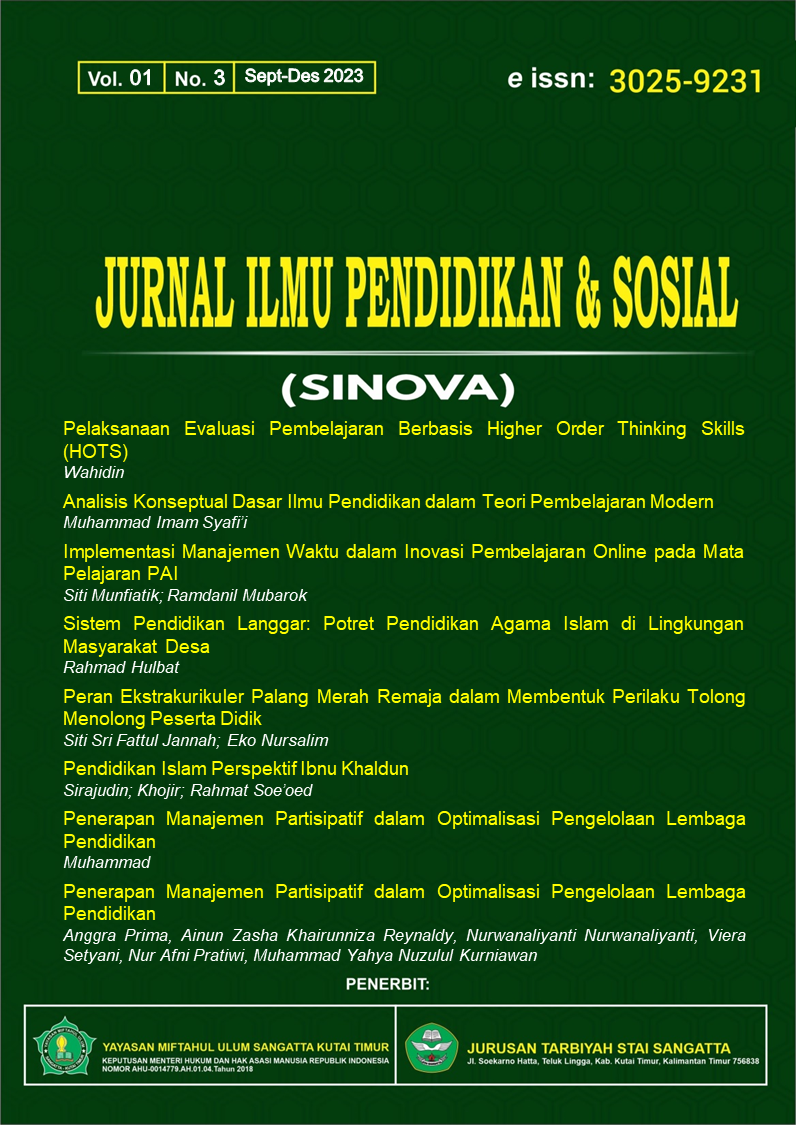
Penerapan Manajemen Partisipatif dalam Optimalisasi Pengelolaan Lembaga Pendidikan
DOI:
https://doi.org/10.71382/sinova.v1i3.115Keywords:
Participatory Management, Optimization, Management of Educational InstitutionsAbstract
This research aims to analyze the concepts of participatory management, the application of participatory management, and the optimization of the management of educational institutions through participatory management. The method used is the library research method. (Library Research). Research results show that the concept of participatory management is an approach in the management of educational institutions that involves the active participation of all members of the educational institution in decision-making, planning, implementation, and evaluation processes. As for implementation through joint decision-making, collaborative teams, empowerment of teachers and students, open communication, and the involvement of parents and the community, optimizing the management of educational institutions is done by strengthening the engagement and motivation of all stakeholders, improving the quality of decision-making, accelerating response to change, and creating a dynamic and responsive learning environment. By empowering teachers, students, parents, and administrative staff, participatory management can create opportunities for greater collaboration and more student-oriented decision-making.
References
Afanas, A., & Balanici, O. (2022). The Role of Participatory Management in the Educational Process. Univers Pedagogic, 74(2), 92–96. https://doi.org/10.52387/1811-5470.2022.2.14
Díez-Garrido, M. (2023). Openness as a New Communication Strategy for Political Parties. A Comparison Between Spanish and Portuguese Websites. Trípodos, 53, 122–142. https://doi.org/10.51698/tripodos.2022.53.01
Dral, G. J., Witte, P. A., & Hartmann, T. (2023). The Impact of Participatory Decision-Making on Legitimacy in Planning: Dilemmas and Tensions in the Dutch Municipal Planning Context. DisP-The Planning Review, 59(1), 98–113. https://doi.org/10.1080/02513625.2023.2229633
Gunawan, A., Rivai, H. A., & Lukito, H. (2023). Pengaruh Manajemen Bakat dan Pengetahuan terhadap Kinerja dan Komitmen Karyawan dalam Perusahaan. Jurnal Informatika, 5(4), 1289–1296.
Handoyo, K., Mudhofir, M., & Maslamah, M. (2021). Implementasi Manajemen Berbasis Madrasah Dalam Peningkatan Mutu Pendidikan Di Madrasah. Jurnal Ilmiah Ekonomi Islam, 7(1), 321–332. https://doi.org/10.29040/jiei.v7i1.1855
Huang, C.-S., & Gong, D.-C. (2021). How Participation Management Influences Work Engagement: The Mediating Role of Perceived Fit and Leader-Member Exchange. International Journal of Business and Management, 14(12), 191. https://doi.org/10.5539/IJBM.V14N12P191
Irianto, H. A. (2017). Pendidikan Sebagai Investasi Dalam Pembangunan Suatu Bangsa. Kencana Prenada Media Group.
Joy, E., Ndubuisi, U., & Enyinnaya, I. (2019). Participative Decision Making and Organisational Performance. Ilorin Journal of Human Resource Management, 3(1), 13–28.
Karim, H. A. (2021). Pendidikan Untuk Pembangunan Berkelanjutan: Pendekatan Manajemen Partisipatif. Arti Bumi Intaran.
Kazu, İ. Y., & Kuvvetli, M. (2023). Navigating the Challenges of Education Management Best Practices for Improving Student Outcomes. Avrupa Bilim ve Teknoloji Dergisi, 49, 68–74. https://doi.org/10.31590/ejosat.1259005
Kujanpää, L., & Pihkola, H. (2023). Developing a Participatory Approach to Support Decision-Making in Waste Management. In Stakeholder Engagement in a Sustainable Circular Economy: Theoretical and Practical Perspectives (pp. 165–191). Springer. https://doi.org/10.1007/978-3-031-31937-2_6
Legi, H., Samosir, L., & Tambunan, L. L. (2023). Manajemen Konflik Dalam Implementasi Kurikulum Merdeka Di Era Digital. Nautical: Jurnal Ilmiah Multidisiplin Indonesia, 2(3), 196–203.
Maolana, I., Darmiyanti, A., & Abidin, J. (2023). Strategi Kepemimpinan Kepala Sekolah Yang Efektif Dalam Meningkatkan Kualitas Guru Di Lembaga Pendidikan Islam. Innovative: Journal Of Social Science Research, 3(4), 83–94. https://doi.org/10.31004/innovative.v3i4.3493
Marzouki, A., Mellouli, S., & Daniel, S. (2022). The Identification of Stakeholders’ Living Contexts in Stakeholder Participation Data: A Semantic, Spatial and Temporal Analysis. Land, 11(6), 798. https://doi.org/10.3390/land11060798
McClellan, J. G. (2023). Collaboration in Organizations. In Oxford Research Encyclopedia of Communication. https://doi.org/10.1093/acrefore/9780190228613.013.1276
Muktamar, A., Iswahyudi, M. S., Salong, A., Wote, A. Y. V., Rahmatiyah, R., Riyadi, S., Kusumawati, M., Rohaeti, L., & Leuwol, F. S. (2023). Manajemen Pendidikan: Konsep, Tantangan, dan Strategi di Era Digital. PT. Sonpedia Publishing Indonesia.
Nurman, M., Yuliejantiningsih, Y., & Roshayanti, F. (2018). Pengaruh Kepemimpinan Partisipatif Kepala Sekolah dan Kompetensi Guru Terhadap Mutu Sekolah Smp Negeri di Kecamatan Bumiayu Kabupaten Brebes. Jurnal Manajemen Pendidikan (JMP), 7(3).
Nurnaningsih, A., Norrahman, R. A., & Wibowo, T. S. (2023). Pemberdayaan Sumber Daya Manusia dalam Konteks Manajemen Pendidikan. Journal of International Multidisciplinary Research, 1(2), 221–235.
Ornoy, H. (2019). Participative Management: The Effect Of The Exposure To And Attitude Of Employees And Managers Towards Participation In The Management Decision-Making Process–A Case Study Of A Public Organisation In Israel. Israel Affairs, 25(3), 431–451. https://doi.org/10.1080/13537121.2019.1593663
Pringgar, R. F., & Sujatmiko, B. (2020). Penelitian Kepustakaan (Library Research) Modul Pembelajaran Berbasis Augmented Reality Pada Pembelajaran Siswa. IT-Edu: Jurnal Information Technology and Education, 5(01), 317–329.
Puspasari, M. D. (2023). Penerapan Kepemimpinan Transformasional Dalam Pengelolaan Madrasah Modern. Refresh: Manjemen Pendidikan Islam, 1(2), 40–47.
Rahmat, A. (2021). Hubungan Sekolah dan Masyarakat: Mengelola Partisipasi Masyarakat dalam Peningkatan Mutu Sekolah. Zahir Publishing.
Rosita, L. (2018). Peran Pendidikan Berbasis Karakter Dalam Pencapaian Tujuan Pembelajaran Di Sekolah. JIPSI-Jurnal Ilmu Politik Dan Komunikasi UNIKOM, 8.
Saharani, D., & Hidayat, R. (2023). Implementasi Competitive Strategy Meningkatkan Mutu Dan Adaptasi Lembaga Pendidikan. Nusantara Journal of Multidisciplinary Science, 1(5), 1011–1022.
Sihombing, D., Gultom, S., & Situmorang, B. (2022). Manajemen Sekolah Berbasis Budaya Lokal: Strategi Meningkatkan Peran & Partisipasi Aktif Stakeholder Mewujudkan Sekolah Bermutu. DEEPUBLISH (Grup Penerbitan CV BUDI UTAMA).
Smit, I., Bam, L., & Zincume, P. N. (2023). Participative Management for Team Effectiveness and Innovation. South African Journal of Industrial Engineering, 34(1), 28–41. https://doi.org/10.7166/34-1-2767
Sopwandin, I., Dewi, I., & Syah, M. (2020). Manajemen Partisipatif Dalam Pengembangan Budaya Religius Peserta Didik. Jurnal Manajemen Pendidikan Islam Al-Idarah, 5(2), 67–74. https://doi.org/10.54892/jmpialidarah.v5i2.75
Su, Z., Chen, J., Guo, H., & Wang, D. (2022). Top Management Team’s Participative Decision-Making, Heterogeneity, and Management Innovation: An Information Processing Perspective. Asia Pacific Journal of Management, 1–23. https://doi.org/10.1007/S10490-021-09752-2
Sulaeman, M. (2018). Urgensi Manajemen Peningkatan Mutu Berbasis Sekolah di Lembaga Pendidikan Islam. Realita: Jurnal Penelitian Dan Kebudayaan Islam, 16(1).
Suryadi, I., Pamungkas, R. W. P., & Wahyudi, F. S. (2023). Peran Kepemimpinan Efektif dalam Meningkatkan Kualitas Manajemen Pendidikan. Journal of International Multidisciplinary Research, 1(2), 129–145.
Ulfiyyati, A., Muhamad, R., & Akbari, I. S. (2023). Demokrasi: Tinjauan Terhadap Konsep, Tantangan, Dan Prospek Masa Depan. Advanced In Social Humanities Research, 1(4), 435–444.
Usman, A. (2023). Peningkatan Mutu Pembelajaran Melalui Manajemen Kelas Partisipatif Guru Dan Siswa. Irsyaduna: Jurnal Studi Kemahasiswaaan, 3(3), 319–329. https://doi.org/10.54437/irsyaduna.v3i3.1180
Viktoriia, Kyfyak., Olena, H. (2021). Participative Management as a Tool to Ensure Strategic Development of Enterprises. Business Navigator, 64(3), 33–38. https://doi.org/10.32847/BUSINESS-NAVIGATOR.64-5
Volpato, A., Eliantonio, M., & Wright, K. (2023). Transparency and Participation in the Face of Scientific Uncertainty: Concluding Remarks. European Journal of Risk Regulation, 14(2), 371–381. https://doi.org/10.1017/err.2023.34
Widadie, F., Bijman, J., & Trienekens, J. (2023). Influence of Communication Openness, Information Exchange, and Intra-organisational Ties on Farmer–Buyer Relationship Continuity: Evidence from Indonesian Vegetables Supply Chains. In Networks in International Business: Managing Cooperatives, Franchises and Alliances (pp. 63–87). Springer. https://doi.org/10.1007/978-3-031-18134-4_5
Yulina, A. R. (2017). Peran Kepala Sekolah Dalam Mengimplementasikan Manajemen Berbasis Sekolah (Mbs) Di Sdn 1 Balegondo Magetan. Kajian Moral Dan Kewarganegaraan, 5(02).
Zein, M. H. M., & Septiani, S. (2021). Manajemen Partisipatif: Sebuah Pendekatan Meningkatkan Peran Masyarakat Dalam Pembangunan Desa. JOURNAL OF ADMINISTRATIVE AND SOCIAL SCIENCE, 2(1), 1–15.
Downloads
Published
How to Cite
Issue
Section
License
Copyright (c) 2023 Muhammad Muhammad

This work is licensed under a Creative Commons Attribution 4.0 International License.








 .
.